
When you look up at the night sky, it’s easy to wonder how far away is the Moon and how something so bright can feel so close yet remain so distant. The truth is, the answer is both simple and fascinating.
The Moon is Earth’s only natural satellite, and while it looks like it’s just “hanging” in the sky, it’s actually traveling through space at an incredible distance from us. In this article, we’ll break down exactly how far away is the Moon, why that distance changes, and what it means for science and space exploration.
The Average Distance Between Earth and the Moon
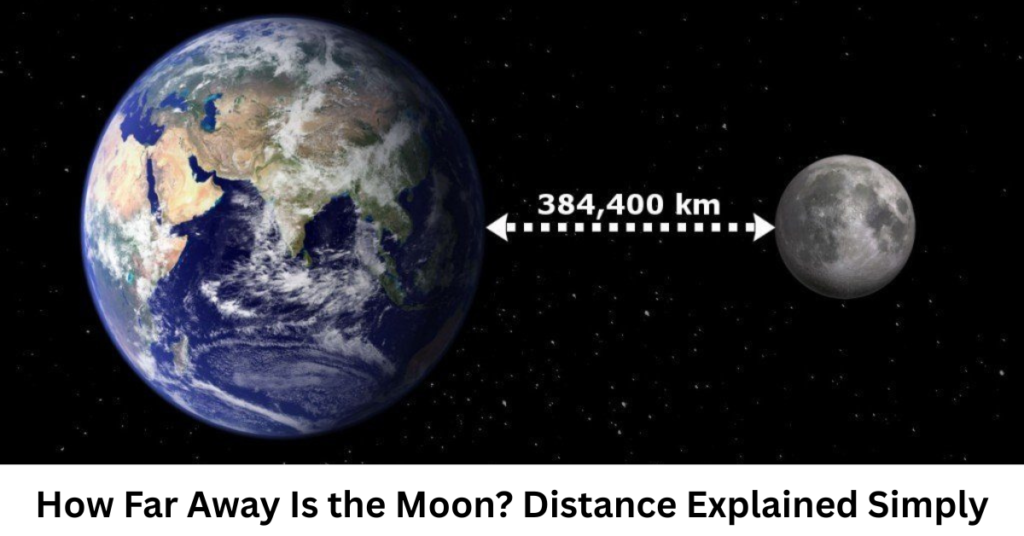
On average, the Moon is about 384,400 kilometers (238,855 miles) away from Earth.
That might sound fixed, but the Moon doesn’t orbit Earth in a perfect circle. Instead, its path is slightly oval-shaped (elliptical), which means the distance is always changing.
To put this into perspective:
- You could line up Earth’s diameter about 30 times between Earth and the Moon.
- A commercial airplane would take about 18–20 days nonstop to reach the Moon.
- Light from the Moon takes about 1.28 seconds to reach Earth.
So when someone asks how far away is the Moon, the answer depends on where it is in its orbit at that moment.
Why the Moon’s Distance Changes
The Moon doesn’t stay at a constant distance from Earth. Instead, it moves closer and farther as it follows its elliptical orbit.
Closest Point: Perigee
At perigee, the Moon is about:
- 363,300 km (225,623 miles) away
This is when the Moon looks slightly larger and brighter in the sky, sometimes called a “Supermoon.”
Farthest Point: Apogee
At apogee, the Moon is about:
- 405,500 km (252,088 miles) away
At this point, it appears a bit smaller and dimmer from Earth.
So when we ask how far away is the Moon, we’re really talking about a range rather than a single number.
Understanding the Moon’s Orbit Around Earth
The Moon has been orbiting Earth for about 4.5 billion years, and it continues to drift away slowly—about 3.8 cm per year.
Key facts about its orbit:
- It takes about 27.3 days to complete one orbit around Earth (sidereal month).
- It rotates at the same rate it orbits, which is why we always see the same side.
- Its gravity influences Earth’s tides, creating high and low tides daily.
This slow but steady movement is also why the question how far away is the Moon will have a slightly different answer millions of years from now.
How Scientists Measure the Distance to the Moon
You might wonder how we even know the exact distance.
Scientists use several precise methods:
1. Laser Ranging Experiments
Astronauts placed reflectors on the Moon during Apollo missions. Scientists shoot lasers at them and measure how long it takes the light to return.
2. Radar Signals
Radio waves are bounced off the Moon and timed as they return to Earth.
3. Orbital Calculations
Modern satellites and space probes track the Moon’s movement with extreme accuracy.
Thanks to these methods, we know exactly how far away is the Moon at any given time.
Why the Moon Feels Closer Than It Is
Even though the Moon is hundreds of thousands of kilometers away, it still feels surprisingly close. That’s because:
- It’s the brightest object in the night sky after the Sun.
- It’s large enough to be seen clearly without a telescope.
- Its gravitational influence is strong enough to move Earth’s oceans.
This visual connection often tricks our brain into underestimating how far away is the Moon in reality.
Fun Comparisons to Understand the Distance
Let’s make the distance easier to imagine:
- Driving nonstop at 100 km/h: ~160 days
- Jet flight: ~16–20 days
- Apollo spacecraft: ~3 days
- Walking: over 9 years without stopping
These comparisons help show just how vast space really is, even when it comes to our closest neighbor.
Why Knowing the Moon’s Distance Matters
Understanding how far away is the Moon isn’t just curiosity—it’s important for science and exploration.
It helps with:
- Planning space missions
- Studying Earth’s tides and climate effects
- Understanding orbital mechanics
- Developing future lunar bases
The Moon is often seen as a stepping stone for deeper space exploration, including missions to Mars and beyond.
FAQs About the Moon’s Distance
1. How far away is the Moon from Earth exactly?
On average, the Moon is about 384,400 km away, but this distance changes as it orbits Earth.
2. Why does the Moon look close if it’s so far away?
Its brightness, size, and visibility in the night sky create the illusion that it is closer than it actually is.
3. Does the Moon move away from Earth?
Yes, it is slowly drifting away at about 3.8 cm per year.
4. How long would it take to reach the Moon?
Spacecraft take about 3 days, while a commercial airplane would take nearly 3 weeks nonstop.
5. Is the distance to the Moon always the same?
No, it varies between about 363,300 km and 405,500 km depending on its orbit.
Conclusion
So, how far away is the Moon really? The answer is: it depends—but on average, it sits about 384,400 km away from Earth. While that number may feel enormous, the Moon remains our closest cosmic neighbor and a constant companion in the night sky.
Understanding this distance not only satisfies curiosity but also deepens our appreciation of space and Earth’s place in the universe. If you look up tonight, remember—you’re gazing at an object that, while far away, is still the closest world beyond our own.