
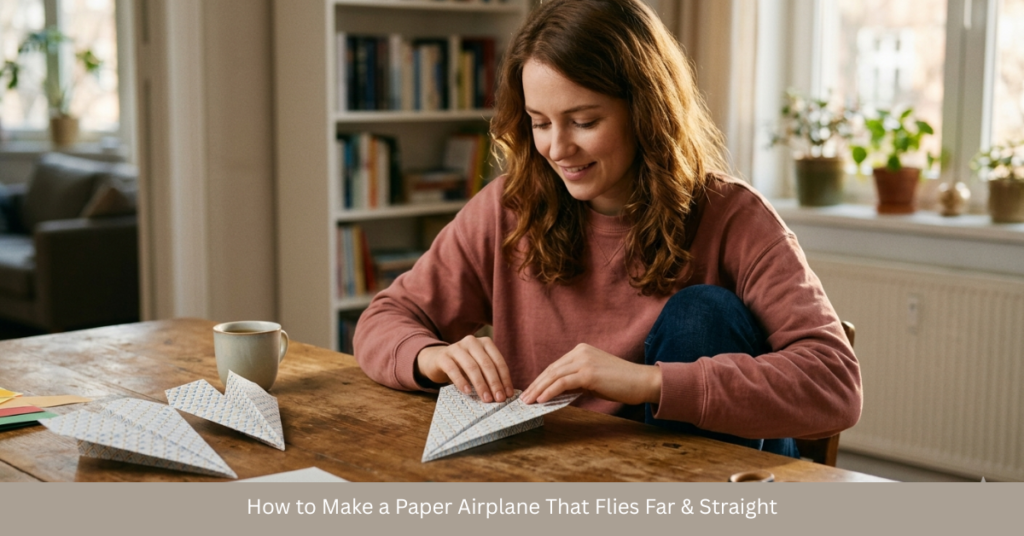

Ever folded a paper airplane that nosedived instantly or barely made it across the room? You’re not alone. Learning how to make a paper airplane that actually flies well is both an art and a bit of science.
In this guide, you’ll discover simple, proven folding techniques, plus expert tips to improve distance, speed, and stability. Whether you want a fast jet, a smooth glider, or something fun for kids, this step-by-step guide has you covered.
How to Make a Paper Airplane Step by Step
Let’s start with a classic design that balances distance and stability.
What You’ll Need
- 1 sheet of A4 or Letter-size paper
- A flat surface
- Your hands (no tools required)
Step-by-Step Instructions
- Fold the paper in half lengthwise
Crease it well, then unfold it to create a center line. - Fold the top corners down
Bring both top corners to the center crease, forming a triangle. - Fold the triangle down
Take the top point and fold it down about halfway. - Fold the top corners again
Bring them toward the center line once more for a sharper nose. - Fold the plane in half
Along the original center crease. - Create the wings
Fold each side down evenly, leaving about 1–2 cm for the body. - Adjust and test
Slightly bend the wings upward for better lift.
This simple method is perfect if you’re looking for how to make a paper airplane easy and fast.
How to Make a Paper Airplane That Flies Far
If distance is your goal, a few tweaks can make a big difference.
Key Tips for Longer Flights
- Use thin but strong paper (like printer paper)
- Keep folds sharp and symmetrical
- Add a slight upward tilt to the wings
- Throw gently—force isn’t everything
A well-balanced design is essential for how to make a paper airplane that flies far and straight.
How to Make a Paper Airplane Jet (Fast Design)
Want speed instead of glide? Try a jet-style airplane.
Steps for a Jet Plane
- Make narrower wings
- Fold the nose tighter for less air resistance
- Keep the body slim
Jet designs are ideal if you’re searching for how to make a paper airplane jet that cuts through the air quickly.
How to Make a Paper Airplane for Kids
Kids need something simple, fun, and reliable.
Best Approach
- Use fewer folds
- Make wider wings for stability
- Avoid overly sharp edges
This makes it easier for beginners learning how to make a paper airplane for kids without frustration.
Different Paper Airplane Styles You Can Try
Once you’ve mastered the basics, experiment with different designs:
Glider
- Wide wings
- Slow, smooth flight
- Great for indoor use
Perfect if you want to learn how to make a paper airplane glider.
Loop Plane
- Slight upward wing bends
- Strong throw needed
Ideal for tricks like how to make a paper airplane that loops.
Spinning Plane
- Uneven wing angles
- Creates a spiral motion
Fun for experimenting with how to make a paper airplane that spins.
How to Make a Paper Airplane Fly Farther
Small adjustments can dramatically improve performance:
- Add tiny folds at the back (wing flaps)
- Keep the nose slightly heavier
- Make sure wings are even
- Test and adjust after each throw
These tricks help with how to make a paper airplane fly farther without changing the design completely.
Common Mistakes to Avoid
Even small errors can ruin your flight:
- Uneven folds → causes drifting
- Too much force → leads to crashing
- Wings too flat → reduces lift
- Thick paper → adds unnecessary weight
Avoiding these ensures your airplane flies smoothly and consistently.
FAQs About Paper Airplanes
1. What is the best paper for making paper airplanes?
Standard printer paper works best. It’s light, flexible, and easy to fold.
2. How do I make my paper airplane go far?
Focus on symmetry, sharp folds, and a gentle throw. Balance matters more than power.
3. Why does my airplane keep crashing?
Check if the wings are even and slightly tilted upward. Also, avoid throwing too hard.
4. Can I make a paper airplane that flies forever?
Not literally forever, but glider designs can stay in the air much longer with proper technique.
5. What’s the easiest design for beginners?
The classic dart plane is ideal for anyone learning step by step how to make a paper airplane.
Conclusion
Learning how to make a paper airplane isn’t just about folding paper—it’s about understanding balance, airflow, and design. With just a few simple techniques, you can create planes that fly farther, straighter, and even perform tricks.
Start with the basic design, experiment with variations, and keep tweaking your folds. The more you practice, the better your planes will perform.
Now it’s your turn—grab a sheet of paper and see how far your airplane can go!