
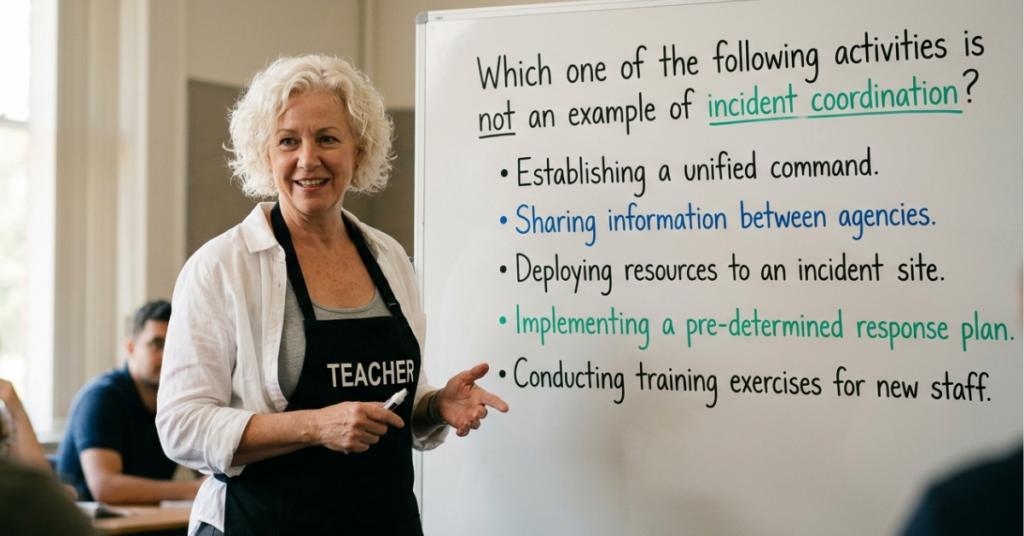

When dealing with emergencies or IT disruptions, understanding which one of the following activities is not an example of incident coordination can make a big difference. Whether you’re preparing for an exam, working in IT service management, or handling real-world incidents, knowing the difference between coordination and unrelated tasks is essential.
In simple terms, incident coordination is all about managing resources, communication, and actions during an incident. But not everything that happens during an incident actually qualifies as coordination. Let’s break it down in a clear, practical way so you can confidently identify what does and does not belong.
What Is Incident Coordination?
Incident coordination refers to the organized effort of managing people, processes, and communication during an incident. It ensures that everything runs smoothly and the issue gets resolved as quickly as possible.
Key Responsibilities of Incident Coordination
- Communicating with stakeholders
- Assigning tasks to relevant teams
- Monitoring incident progress
- Escalating issues when needed
- Ensuring proper documentation
Think of it as the “control center” of incident management.
Examples of Incident Coordination Activities
To understand what does not count, we first need to look at what does. Common incident coordination activities include:
1. Communication Management
Keeping everyone informed—team members, customers, and management.
2. Resource Allocation
Assigning the right people and tools to resolve the issue.
3. Escalation Handling
Raising the issue to higher-level experts when needed.
4. Status Tracking
Monitoring progress and ensuring deadlines are met.
5. Incident Documentation
Recording updates, actions, and outcomes for future reference.
Which One of the Following Activities Is NOT an Example of Incident Coordination?
Now to the main question: which one of the following activities is not an example of incident coordination?
The Correct Answer (Explained Clearly)
An activity like actually fixing the technical issue (e.g., repairing a server or debugging code) is not incident coordination.
Why Not?
Because:
- Coordination = Managing the process
- Resolution = Doing the technical work
These are related but different roles.
Incident Coordination vs Incident Resolution
Understanding this distinction is key.
Incident Coordination
- Focuses on who does what
- Ensures communication flows smoothly
- Oversees the entire process
Incident Resolution
- Focuses on fixing the problem
- Involves technical expertise
- Carried out by engineers or specialists
Quick Comparison
| Aspect | Coordination | Resolution |
|---|---|---|
| Role | Manager/Coordinator | Technician/Engineer |
| Focus | Process & communication | Problem-solving |
| Example | Assigning tasks | Fixing a broken system |
Common Misconceptions
Many people confuse coordination with other tasks. Here are a few examples:
Misconception 1: Troubleshooting is Coordination
No, troubleshooting is part of resolution.
Misconception 2: Writing Code Fixes is Coordination
This is technical work, not coordination.
Misconception 3: Monitoring Systems is Always Coordination
It depends—monitoring can support coordination, but it’s not always part of it.
How to Identify Non-Coordination Activities
If you’re unsure whether an activity fits, ask yourself:
- Is this managing people or fixing the issue?
- Does it involve communication or technical execution?
- Is it guiding the process or solving the problem directly?
If it’s about doing the work, it’s likely not coordination.
Why This Knowledge Matters
Understanding which one of the following activities is not an example of incident coordination is important because:
- It helps in IT certifications and exams
- Improves team role clarity
- Enhances incident response efficiency
- Prevents confusion during high-pressure situations
FAQs
1. What is incident coordination in simple terms?
It’s the process of managing communication, tasks, and resources during an incident to ensure smooth resolution.
2. Is troubleshooting part of incident coordination?
No, troubleshooting is part of incident resolution, not coordination.
3. Can one person handle both coordination and resolution?
Yes, in small teams, one person may do both, but they are still separate roles.
4. Why is coordination important during incidents?
It ensures everyone is aligned, reduces delays, and speeds up resolution.
5. What is the easiest way to remember the difference?
Coordination = managing the process
Resolution = fixing the problem
Conclusion
So, when asked which one of the following activities is not an example of incident coordination, remember this simple rule: if the activity involves fixing the issue directly, it’s not coordination—it’s resolution.
Keeping this distinction clear will not only help you in exams but also make you more effective in real-world incident management. If you want to dive deeper, explore related topics like incident lifecycle, IT service management frameworks, and response strategies to sharpen your understanding even further.