
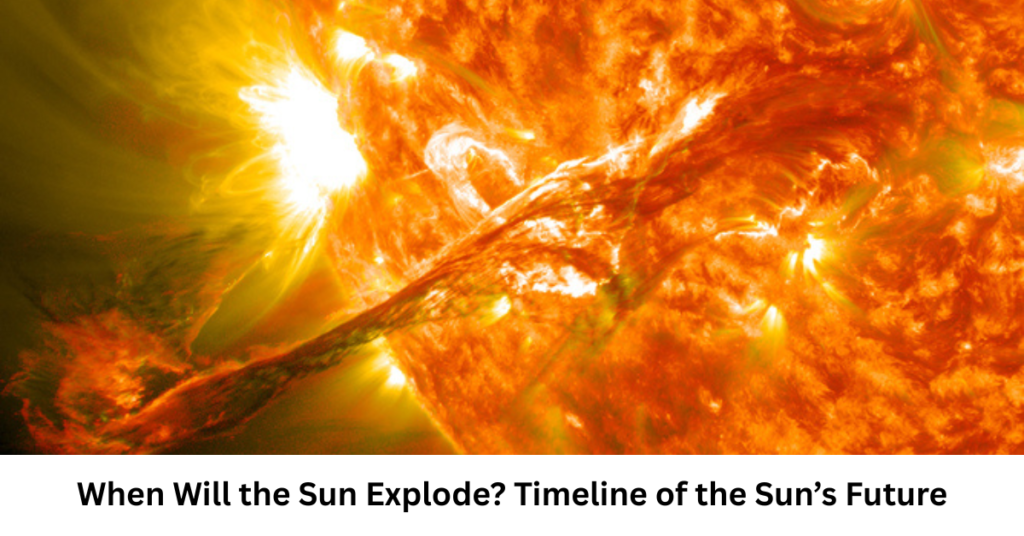

If you’ve ever wondered when will the sun explode, you’re not alone. It’s one of those space questions that sounds dramatic, even a little scary—but the truth is far more fascinating than alarming.
The Sun is not expected to “explode” like a movie-style supernova. Instead, it will go through a slow and predictable life cycle that ends in a very different way. In this article, we’ll break down what scientists actually know about the Sun’s future, how long it has left, and what will really happen when it reaches the end of its life.
The Life Cycle of the Sun: It’s Not a Sudden Explosion
To understand when will the sun explode, we first need to understand what kind of star it is.
The Sun is a G-type main-sequence star (G dwarf), which means it produces energy by fusing hydrogen into helium in its core. This process is extremely stable and has been going on for about 4.6 billion years.
Key stages of the Sun’s life:
- Main Sequence (Now): Stable hydrogen burning phase
- Red Giant Phase: Expansion as hydrogen runs out
- Planetary Nebula: Outer layers are shed
- White Dwarf: The final cooling core remains
So, instead of a sudden explosion, the Sun gradually transforms over billions of years.
So, When Will the Sun Actually Change?
Scientists estimate the Sun has about 5 billion years left in its current stable phase. After that, major changes begin—but not in a violent explosion.
Here’s a simplified timeline:
- In ~5 billion years: Hydrogen in the core runs low
- Red Giant phase begins: The Sun expands massively
- Earth’s fate: Likely becomes uninhabitable long before this
- Final stage: The Sun becomes a white dwarf
So if you’re searching when will the sun explode countdown, the honest answer is: there is no countdown to an explosion—just a very long transformation process.
Why the Sun Won’t Explode Like a Supernova
A common misconception is that all stars explode at the end of their life. That’s not true.
Supernova explosions only happen in massive stars, typically at least 8 times the mass of the Sun.
Our Sun:
- Is too small to explode
- Lacks the mass needed for a supernova
- Will end quietly as a white dwarf
Instead of a dramatic blast, it will shed its outer layers gently, creating a glowing cloud called a planetary nebula.
What Will Happen to Earth?
Long before the Sun reaches its final stages, Earth will already face extreme changes.
Expected impacts over time:
- Rising temperatures make oceans evaporate
- Atmosphere becomes unstable
- Life becomes impossible
This could happen in about 1–2 billion years, long before any major solar transformation.
So while people ask when will the sun explode, the more important question is how long Earth can remain habitable.
The Final Stage: A Quiet Ending, Not a Cosmic Explosion
When the Sun enters its final phase, it will:
- Expand into a red giant
- Lose its outer layers
- Leave behind a dense white dwarf
This white dwarf will slowly cool over trillions of years. No explosion, no sudden destruction—just a fading ember in space.
Common Myths About the Sun’s End
Let’s clear up a few misunderstandings:
Myth 1: The Sun will explode suddenly
False. It will slowly evolve over billions of years.
Myth 2: We need to worry about it soon
False. The timeline is unimaginably long compared to human history.
Myth 3: It will become a supernova
False. The Sun is not massive enough for that.
FAQs About the Sun’s Future
1. When will the sun explode in real science terms?
The Sun will not explode. It will expand into a red giant in about 5 billion years.
2. Is there a real when will the sun explode countdown?
No. There is no countdown because the process is gradual, not sudden.
3. Will humans be alive when the Sun changes?
Very unlikely. Earth will likely become uninhabitable long before that stage.
4. Could the Sun ever become dangerous suddenly?
No. The Sun is extremely stable and changes on a very slow cosmic scale.
5. What will replace the Sun after it dies?
It will become a white dwarf, slowly cooling over time.
Conclusion: The Sun’s Future Is Slow, Not Sudden
So, when will the sun explode? The simple answer is—it won’t.
Instead of a dramatic explosion, the Sun will age gracefully over billions of years, eventually becoming a red giant and then a white dwarf. This process is slow, predictable, and already well understood by scientists.
The real takeaway is that the Sun’s life is measured in billions of years, not human lifetimes. So while it’s fun (and a little mind-blowing) to think about space endings, there’s absolutely no immediate danger.
If you’re curious about space, stars, or the universe’s future, there’s a whole cosmos of fascinating topics waiting to explore next.