
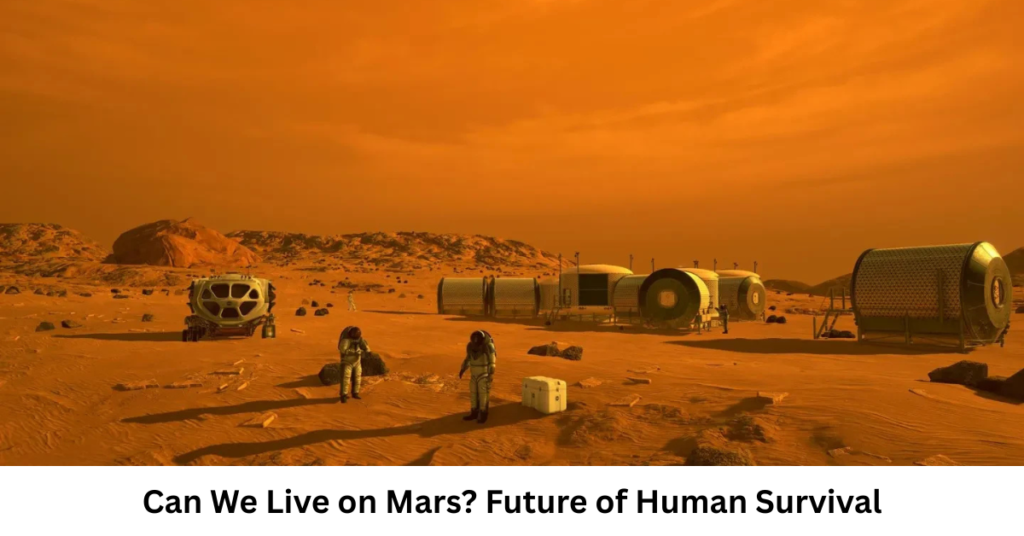

The question can we live on Mars has moved from science fiction into serious scientific discussion. With space agencies like NASA and private companies like SpaceX investing heavily in Mars exploration, the idea of humans settling on the Red Planet is no longer just a dream—it’s a potential future.
But the real question is: is Mars actually livable for humans? In this article, we’ll break down the science, challenges, and possibilities in a simple, human-friendly way.
Why Mars Is So Interesting for Human Life
Mars is often called Earth’s “sister planet” because it has some similar features:
- A 24.6-hour day (almost like Earth)
- Ice caps made of water and carbon dioxide
- Evidence of ancient rivers and lakes
- A surface that could potentially support habitats
Because of these similarities, scientists often ask: can we live on Mars in the future with the right technology?
However, similarity doesn’t mean safety. Mars is still extremely hostile to human life.
The Biggest Challenges of Living on Mars
Before we imagine cities on Mars, we need to understand the serious challenges.
1. Extreme Temperatures
Mars is incredibly cold, with temperatures dropping to -125°C (-195°F) near the poles. Even at the equator, it rarely gets warm.
2. No Breathing Oxygen
The atmosphere is about 95% carbon dioxide, which means humans cannot breathe without life-support systems.
3. Weak Gravity
Mars has only 38% of Earth’s gravity, which could affect:
- Muscle strength
- Bone density
- Long-term health
4. Radiation Exposure
Unlike Earth, Mars has no strong magnetic field. This means harmful solar radiation reaches the surface directly.
5. Dust Storms
Mars experiences massive dust storms that can last for weeks and cover the entire planet.
All of these factors make the idea of can we live on Mars extremely complex.
How Scientists Plan to Make Mars Habitable
Even with these challenges, researchers are working on creative solutions.
1. Building Protective Habitats
Future Mars homes may be:
- Underground bases
- Dome-shaped shelters
- 3D-printed structures using Martian soil
These would protect humans from radiation and extreme temperatures.
2. Oxygen Production Systems
NASA’s MOXIE experiment already converts CO₂ into oxygen. This is a huge step toward survival.
3. Water Extraction
Frozen water beneath Mars’ surface could be melted and purified for drinking and farming.
4. Food Production
Astronauts may grow food using:
- Hydroponic farming
- Artificial lighting systems
- Controlled greenhouse environments
These technologies are essential if can we live on Mars becomes a reality.
NASA and SpaceX Plans for Mars Colonization
NASA aims to send humans to Mars in the 2030s, focusing first on short missions. Meanwhile, SpaceX, led by Elon Musk, has a more ambitious goal: building a self-sustaining city on Mars.
Key goals include:
- Sending cargo missions first
- Testing long-duration human survival
- Developing reusable spacecraft
- Creating fuel production on Mars
These steps show that Mars colonization is not just theory anymore.
What Life on Mars Might Actually Look Like
If humans do settle there, life will be very different:
- People will live in enclosed habitats
- Food will be grown indoors
- Outdoor activity will require space suits
- Communication with Earth will have time delays
So, when asking can we live on Mars, the answer is not just “yes or no”—it depends on how well we adapt.
Will Humans Ever Truly Live on Mars?
The honest answer is: maybe, but not easily.
We are still far from creating a fully Earth-like environment on Mars. However, with advancing technology, humans may live in controlled colonies within this century.
The idea of Mars as a “backup planet” for humanity is driving much of today’s space research.
FAQs
1. Can we live on Mars without a spacesuit?
No. Mars has no breathable oxygen and extreme temperatures, so a spacesuit is essential.
2. How long can humans survive on Mars?
Without protection, only a few minutes. With habitats and life support, potentially long-term.
3. Is there water on Mars?
Yes, mostly in frozen form under the surface and at the polar ice caps.
4. What is the biggest problem for living on Mars?
Radiation, lack of oxygen, and extreme cold are the biggest challenges.
5. When could humans live on Mars?
Experts estimate the first human missions could happen in the 2030s or 2040s.
Conclusion
So, can we live on Mars? The answer is cautiously hopeful. While Mars is not naturally habitable, science and innovation are slowly turning the impossible into possible.
From oxygen production to underground shelters, humanity is actively building the foundation for future Mars living. It won’t be easy, and it won’t be soon—but it might just happen within our lifetime.
The journey to Mars is not just about survival—it’s about evolution, exploration, and pushing the limits of what humans can achieve.