
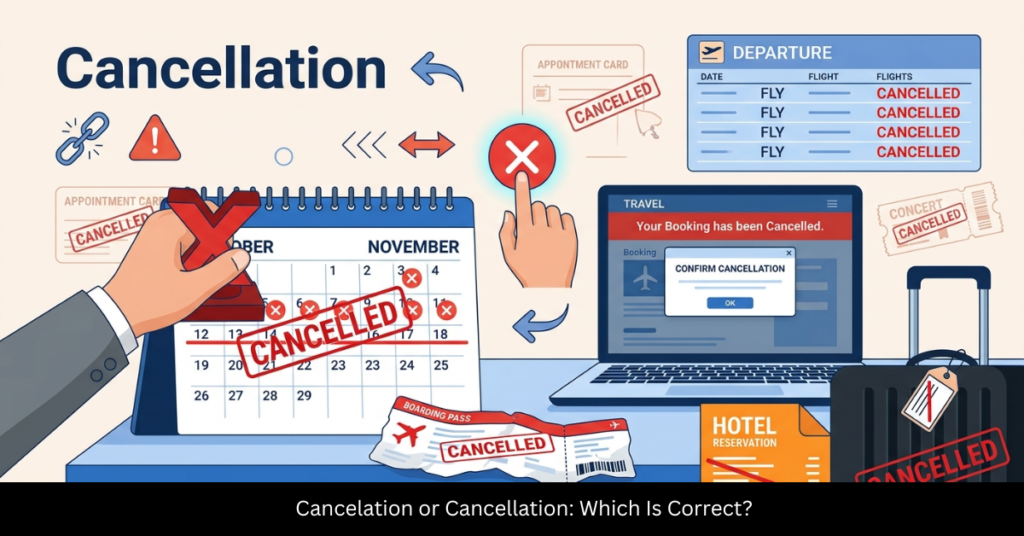

You’ve probably paused mid-sentence wondering: is it “cancelation or cancellation”? You’re not alone. This common spelling dilemma trips up writers, students, and even professionals. The good news? There’s a clear explanation behind both versions—and once you understand it, you’ll never second-guess yourself again.
In this guide, we’ll break down the difference, explain why both forms exist, and show you when to use each one confidently.
Cancelation or Cancellation: What’s the Difference?
At its core, the debate between cancelation or cancellation comes down to regional spelling differences.
- Cancellation (with double “l”) is the standard and most widely accepted spelling
- Cancelation (with one “l”) is less common but still technically correct in American English
Quick Answer:
- Use cancellation in most cases
- Use cancelation only if you’re following specific American style preferences
Why Are There Two Spellings?
The variation exists because of how English evolved differently in the United States and the United Kingdom.
British English Influence
British English tends to double consonants when adding suffixes:
- cancel → cancellation
- travel → travelling
American English Simplification
American English often simplifies spellings:
- cancel → cancelation (sometimes)
- travel → traveling
However, here’s the twist: even in American English, “cancellation” remains far more popular.
Which One Should You Use?
If you want to stay safe and professional, follow this rule:
Use “Cancellation” When:
- Writing for a global audience
- Creating formal content (blogs, emails, academic work)
- You’re unsure which version to choose
Use “Cancelation” When:
- Following a strict American style guide that prefers simplification
- Matching brand-specific spelling rules
In real-world usage, cancellation dominates across search engines, publications, and official documents.
Examples in Sentences
Seeing both forms in action makes the difference clearer:
With “Cancellation”
- The flight cancellation was announced early in the morning.
- You’ll receive a refund after the subscription cancellation.
With “Cancelation”
- The event cancelation surprised everyone.
- There was a delay in processing the order cancelation.
Common Grammar Rule Behind It
The confusion often comes from a general spelling rule:
When adding a suffix like -ation, some words double the final consonant.
Examples:
- admit → admission
- permit → permission
- cancel → cancellation
But English isn’t perfectly consistent—which is why both forms exist.
Common Mistakes to Avoid
Here are a few pitfalls to watch out for:
- Mixing both spellings randomly in one document
- Assuming “cancelation” is incorrect (it’s not—just less common)
- Ignoring your audience’s preferred English style
Consistency is key. Pick one version and stick with it.
FAQs
1. Is “cancelation” wrong?
No, it’s not wrong. It’s an accepted variant in American English, but it’s rarely used compared to “cancellation.”
2. Which spelling is more common worldwide?
“Cancellation” is far more widely used across both British and American English.
3. Should I use one spelling for SEO?
Yes—“cancellation” is better for SEO due to higher search volume and recognition.
4. Why does “cancel” sometimes have double “l”?
It follows a pattern where certain suffixes cause consonant doubling, especially in British English.
5. Do style guides prefer one version?
Most major style guides and dictionaries prefer “cancellation” as the standard spelling.
Conclusion
So, when it comes to cancelation or cancellation, both are technically correct—but one clearly stands out. “Cancellation” is the safer, more widely accepted, and SEO-friendly choice.
If you’re writing professionally or for a broad audience, stick with the double “l” version. It keeps your content polished, consistent, and easy to understand.
Still unsure? When in doubt, go with what readers expect—and that’s almost always cancellation.