
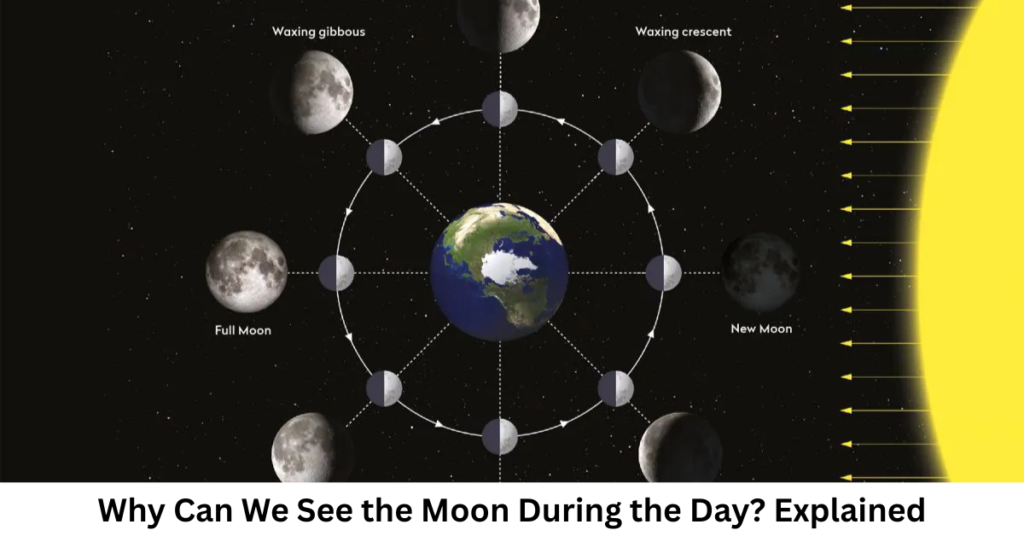

Have you ever looked up at a bright blue sky and suddenly noticed the Moon quietly floating there? It almost feels like it doesn’t belong, right? This leads many people to ask a common question: why can we see the moon during the day when the Sun is shining so brightly?
The truth is, the Moon doesn’t disappear in daylight—it’s always there. What changes is our ability to see it. Let’s break down the science in a simple and fascinating way.
The Moon Is Always in the Sky—Day or Night
One of the biggest misconceptions is that the Moon only appears at night. In reality, the Moon orbits Earth continuously, completing a full cycle every 27.3 days.
That means at any given time:
- The Moon is somewhere above Earth
- Half of it is always illuminated by the Sun
- Its visibility depends on its position relative to Earth and the Sun
So, why can we see the moon during the day? Because it’s already there—daylight just makes it harder (or easier) to notice depending on conditions.
How Sunlight and Sky Brightness Affect Moon Visibility
During the day, the sky looks blue because sunlight scatters in Earth’s atmosphere. This bright background usually hides faint objects like stars—but the Moon is different.
Here’s why the Moon still stands out:
1. The Moon Reflects Strong Sunlight
The Moon doesn’t produce its own light. It reflects sunlight, making it surprisingly bright in space.
2. It Is Close Enough to Be Visible
Compared to stars, the Moon is extremely close to Earth, so it appears much larger and brighter.
3. Contrast Matters
Even in a bright sky, the Moon can outshine the background when conditions are right.
This combination explains why can we see the moon during the day on many clear afternoons.
Moon Phases and Daytime Visibility
The Moon’s position in its orbit affects when we can see it.
Full Moon
- Visible mostly at night
- Rises at sunset and sets at sunrise
First Quarter Moon
- Often visible during the afternoon and early evening
- One of the easiest daytime moons to spot
Waning Crescent
- Can appear in the early morning daylight
So depending on its phase, the Moon may be visible in both day and night skies.
The Science Behind It: Light, Atmosphere, and Perception
Let’s go a little deeper into the science.
Rayleigh Scattering
Earth’s atmosphere scatters shorter wavelengths of light (blue), making the sky bright. This reduces contrast for faint objects but not for the Moon.
Brightness vs. Background
The Moon’s surface reflects about 12% of sunlight. While not extremely reflective, it is still bright enough to compete with daytime sky brightness.
Human Vision Limits
Our eyes adapt to brightness. If the Moon is high enough and the sky is clear, our vision can detect it even in daylight.
All these factors work together to explain why can we see the moon during the day under the right conditions.
Best Times to Spot the Moon in Daylight
If you want to catch the Moon during the day, timing matters:
- Late morning to early afternoon (first quarter phase)
- Just before sunset (waxing gibbous phase)
- Clear, cloudless skies
- High Moon position in the sky
A helpful tip: look for it when the Sun is not directly in the same part of the sky.
Why We Don’t Always Notice It
Even though the Moon is often visible, we miss it because:
- We expect it only at night
- The bright sky reduces contrast
- We are usually focused on ground-level activities
Once you start looking for it, you’ll notice it more often than you think.
FAQs
1. Why can we see the moon during the day sometimes?
Because the Moon reflects sunlight and can be bright enough to stand out against the daytime sky when conditions are right.
2. Is it normal to see the Moon in daylight?
Yes, it is completely normal. It depends on the Moon’s phase and position.
3. Why is the Moon sometimes invisible during the day?
It may be too close to the Sun in the sky or not illuminated enough from our viewpoint.
4. Can you see stars during the day too?
No, stars are much dimmer than the Moon and get completely washed out by daylight.
5. Does the Moon change position during the day?
Yes, it moves with Earth’s rotation and its orbit, so its position in the sky constantly changes.
Conclusion
So, why can we see the moon during the day? The answer lies in a mix of orbital mechanics, sunlight reflection, atmospheric scattering, and simple geometry. The Moon is always there—it just becomes more or less visible depending on how it aligns with the Sun and Earth.
Once you understand this, daytime moon sightings stop feeling mysterious and start feeling like a beautiful reminder of how dynamic our sky really is. Next time you’re outside during the day, take a moment to look up—you might just spot it quietly watching over Earth.